Showing posts with label Architecture. Show all posts

Friday, January 25, 2008

ENOUGH WITH THE DAMN CODE COVERAGE ALREADY!

Whew!

Sorry about that, I just need to rant a little...

Here's what's got me so upset; TDD is a great cool thing. Everybody should be doing it. It's just the best thing since sliced bread, fluffy puppies and free Wi-Fi as Starbucks all rolled into one.

Now, I am NOT a TDD guru by any means. I've read some articles, tried rolling it into my approach and have had great results. I learn a little more everyday, and my understanding increases over time. If you really want to geek out on it you should talk to guys like Steve Harman and Jay Wren!

But there is an evil specter lurking that is threatening to ruin it all.

Code coverage.

Well, maybe not code coverage, but the way people with only a passing knowledge of TDD cling to code coverage like it's the last Red Bull in the fridge. The people who don't understand that the point of unit testing is not to increase code coverage at all cost, but to ensure your code does exactly what it is supposed to do; no more and no less.

I come not to bury code coverage, it's a perfect way to see what code is being tested, and more importantly what code is not being tested.

Here's where I get frustrated with peoples attitudes to code coverage (henceforth referred to at CC because I'm a lazy typist); there is a perception that a high CC number will guarantee quality code. That's simply not the case as you can hide a lot of skeletons behind a big enough door.

One "trick" I've seen to increase CC is to simply test EVERY method on the public interface of an object. This sucks.

My philosophy is that I really don't care about the individual gets/sets on a class. And to be honest, I don't like explicit tests of public methods on entities either. My belief is that you test the features. If you then find that there are methods and properties on a class that aren't being covered you have two options; either your tests suck or you don't need that property/method.

So maybe your tests suck. The best way around that is to make sure you write your tests first, THEN write your code. If you approach your tests like you approach your business requirements (user stories drive unit tests maybe?) and your test are meaningful this shouldn't be a problem, right?

Or maybe you don't need the property/method in question. I'm a big fan of pruning classes. If there is a method property on a class that never gets used why keep it? It sits there like a parasite, consuming maintenance costs and provides nothing in return. I say get rid of it!

We as developers/architects/information workers/whatever need to educate ourselves, our co-workers and are clients on this. High CC is NOT a panacea! The quality and intelligence of your tests is what ensures you are not developing crap-ware! Please, write your tests first, make sure all the features you develop are well tested. Review your co-workers tests and have them review yours. And if a high CC number is your goal look at what you are testing and don't be afraid to trim unused code!

OK, I feel better now. Code on!

Friday, January 11, 2008

Codemash Day 1 part 2

After my "Ask the Exports" time, I headed over to see Keith Elder talk about Microsoft Workflow. The meat of his presentation can be found here. It was an bit of an entry level talk, which I think is desperately needed. There are still a lot of misconceptions out in the Enterprise community about what Workflow is, how it works and how it fits in with things like the .NET framework overall and Biztalk. He's doing an more "advanced" talk later today "custom activities" which I'm looking forward to.

After that I went to see Dustin Campbell do some F# stuff. I was playing with F# a bit before my laptop died (Note to Dell, you actually have to plug the fans in for them to cool the laptop down.) I haven't really had time to re-install and get back into it. Dustin's talk was almost SRO; functional programming, F# in particular, seems to be something that has gathered a lot of interest.

After dinner, I got to play a lot of "Rock Band" with Keith Elder and Scott Hanselman. Keith is scary good at the "Guitar Hero" type games. Scott claims he's never played the game before, but he did a great job on the drums! As for me... well, have I even mentioned how much "Guitar Hero"is NOT like really playing the guitar...

... speaking of playing guitar, the "CodeMash jam session" also happened last night. I didn't feel like dragging my rig up (I already got enough shit from Kaufman and Wingfield about my "larger-than-necessary suitcase) and I'm kind of glad I didn't. Most of the group seemed to be older guys with acoustics play country and CSN stuff. I doubt any of them know any "Iron Maiden", "Helloween" or even "Limozeen!" I'll track Dustin down later and make him a deal for next year; if he brings his stuff, I'll bring mine.

OK, drink now, more writing later.

Thursday, January 10, 2008

CodeMash, Day One Part One

Well, day one for me got off to a "bumpy" start. I request a wake up call for 7:00 intending to work out, and get downstairs in plenty of time for a little breakfast and the beginning of Neal Ford's keynote. Well, unfortunately, my wake up call didn't arrive till 8:00, so I didn't get to work out, missed breakfast and missed the first few minutes of the keynote.

One that subject...

I really dig what Neal Ford is saying about dynamic languages. I've been playing with Iron Python for a little while now and I see a lot of benefit in it, although it's still a bit "rough" in my opinion. If I never end up using it in a production project, it has made me re-think the way I do things in C#. He said something in his presentation that got a little chuckle out of me; compilers are basically weak unit tests and spell checkers. I remember being in school and hearing a lot of my fellow students in the computer lab "I can't understand why it didn't work, it compiled." I didn't think I would hear that after I left school, but I hear it at least once a year from co-workers. He also beat the testing drum, which I'm all for. I really wish this philosophy would catch on more widely in software development. I don't know why, but I'm still surprised when I meet with a client and find out that they have NO unit testing practices in place at all! I've been doing it so long myself, that I can't imagine developing without it.

From there I went to see Joe O'Brien present "Ruby:Testing Mandatory." I have to admit, I was definitely handicapped here since I have zero experience with Ruby, but I'm always interested in anything that can enhance my test-driven chops (very helpful when I evangelize this to clients). It did get me more interested then I had been in Ruby. I have been playing with Iron Python for awhile now, but I've decided I need to make some time for Ruby as well.

After that I went to see Jay Wren talk about Castle. I've heard a lot about Castle, but never really used it. It was pretty interesting.

Scott Hanselman's keynote was great! Had a great, funny intro followed by some very cool stuff for IIS 7. I've been playing with IIS 7 for a few months, but clearly haven't even scratched the surface with the HTTP Modules. More stuff to start playing with when I get home.

Served my first tour of duty in the "Ask the Experts" lounge. It was pretty cool; I didn't get a lot of people coming in for "hard-core" stuff; got one person looking for book recommendations (but that's another blog post), one person who had an interesting challenge which I will blog about later, but for the most part it was kind of an hour and hanging out and talking with Catherine Devlin and Darrell Hawley. I've never met Catherine, and if I want to continue learning Python, I should definitely start reading her blog. I hadn't seen Darrell in awhile and it was fun to talk to him again.

Off to the next session. To be continued...

Monday, November 05, 2007

A Blast From The Past

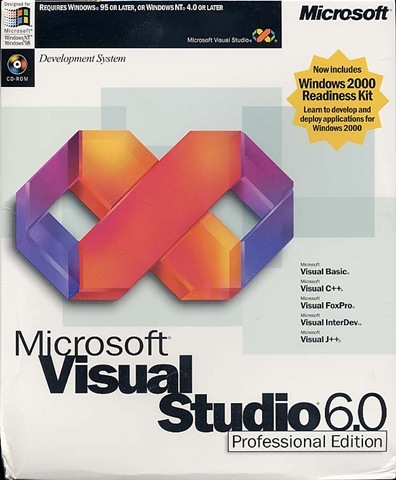
I had a bit of an unusual assignment from a client last week. I had to find a copy of Visual Interdev. Yeah, that one.

  MS_VStudio6Pro

The client in question has system that exports information from their common data model into a specialized one depending on client and purpose. Basically it dynamically crates an Access database from scratch and then copies data into it. The problem is that it does all this in VBScript. It's a ton of processing, and it all occurs in the pages life cycle. Understandably, this causes issues when the client has either a lot of data to export, or a complex destination schema. They are running into the inevitable problem now; processes are timing out.

The application is a ASP Classic web application written in notepad. For the time it was written, and the tools that were available to the developer, it's a pretty well designed and built application, but it's definitely showing its age.

The client wants to convert this to .NET, which I am 100% behind. The problem comes when a client with a system based on old technology wants to simply "convert" the application from one platform to another. The client in question hasn't indicated that this is their mind set, but I've had several clients in the past who have felt I should just be able to run their ASP Classic application through a conversion wizard and be done with it, so I'm mentally getting my ducks in a row if this turns out to be the case.

Not only does technology change, but architectural techniques and practices evolve. A design which may have made sense even five years ago can easily be rendered obsolete by changing business needs just as much by advances in technology.

The key problem with the current application is that the majority of the heavy lifting takes place in the page life cycle. Doing a "one-to-one" conversion from ASP Classic to .NET will make it run a bit faster, but you still have the underlying problem; the wrong part of the application is doing all the work. Sure, the increased performance may help for a while, but eventually there is going to be more and more data as their client base increases and they are going to have the same problem again. By performing a conversion like this the client is just reinvesting  in the wrong architecture.

In this case, it's clearly time for a ground-up redesign of the application.  Clients can often balk at this as on the surface it can present a larger investment; discovery must be done, a design phase is required and it's likely that nothing from the previous version can be salvaged.

But this situation also presents a lot potential positives that may sway a client as well. For one thing, the promise of a system that will grow with the business, not require the business to grow around it. An opportunity to overhaul the user experience may be a way to increase productivity. Perhaps your client have been clamoring for services that your current architecture can't support. Now is the time to look into including these and perhaps introducing new revenue streams. There are lots of ways to find ROI (besides just "Oh, it will work better") in situations like these, and it's very important to find these to make the redesign attractive to the client.